Description
Repairing a Cracked House
Are cracks appearing in your house or continuing to widen? Before selecting a repair method, it is essential to identify their cause and determine whether the movement is still active.
TES TECHNIFOR monitors cracks, stabilises foundations, carries out underpinning work and repairs damaged structural elements.
For this type of work on private houses, TES TECHNIFOR operates exclusively in Lorraine.
A Crack Is a Symptom, Not a Diagnosis
A crack may indicate movement within the structure, but its appearance alone does not always reveal the underlying cause.
Cracking may result from:
-
ground movement or differential settlement;
-
shrink–swell movement in clay soils;
-
inadequate or non-uniform foundations;
-
fill or soils with variable bearing capacity;
-
inadequate drainage or changes in moisture conditions around the house.
This list is not exhaustive, and several factors may be involved. Cracks should therefore not simply be filled without first investigating their cause.
The G5 Geotechnical Investigation (as per NF P94-500)
A G5 geotechnical diagnostic investigation is intended to assess defects affecting an existing structure, identify their geotechnical causes and guide the selection of appropriate repair solutions.
A G5 investigation is not mandatory in every case. However, it is strongly recommended when the cause of cracking remains uncertain, before underpinning work and particularly in connection with a drought-related insurance claim.
Initial investigations or documents prepared during an insurance assessment, particularly when they present ground investigation results without a complete geotechnical interpretation, may not sufficiently characterise the soil or accurately establish its role in the damage.
Where doubts remain, conclusions are insufficiently substantiated or insurance cover is declined, the homeowner may commission an independent geotechnical engineering consultancy to carry out a G5 investigation.
For a private homeowner acting as a non-specialist client, this independent opinion provides valuable technical protection. It supplies a reasoned analysis that can be used to:
-
understand the probable cause of the damage;
-
assess the relevance of the proposed solutions;
-
compare recommendations and quotations;
-
participate knowledgeably in discussions with experts, contractors and the insurer.
The investigation provides objective technical evidence for the case, although it cannot determine the insurer’s final decision regarding cover.
In Lorraine, TES TECHNIFOR can provide homeowners, upon request, with the contact details of independent engineering consultancies. The homeowner remains free to choose their own consultant and enters into a direct contractual relationship with the selected firm.
Independence of the Geotechnical Engineering Consultancy
G5 and G4 assignments are generally undertaken by a geotechnical engineering consultancy, also commonly referred to as a ground engineering consultancy. Both assignments may be entrusted to the same consultancy to maintain continuity between the initial diagnosis and supervision of the work.
To ensure the impartiality of its analyses and protect the homeowner’s technical interests, the consultancy must be independent of the contractor carrying out the work. It should preferably be selected and appointed directly by the homeowner or their project manager and should not act as a subcontractor to the contractor.
This independence allows the consultancy to assess the proposed solutions freely, verify their compliance with the studies and report any deviations identified during the work.
When a geotechnical engineering consultancy is recommended by TES TECHNIFOR, it retains complete technical independence and remains solely responsible for its investigations, calculations and conclusions.
Accurately Monitoring Crack Movement
Monitoring the development of cracks helps determine whether movement is still active or whether the structure is becoming stable.
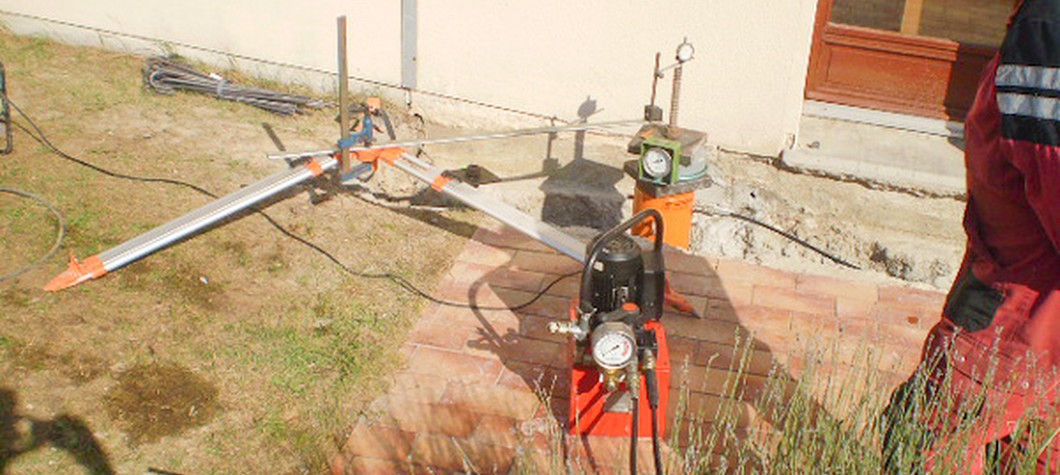
TES TECHNIFOR can install connected crack monitoring gauges that accurately measure changes in crack width over time.
Regular, time-stamped readings can be used to:
-
monitor movement over an extended period;
-
identify phases during which cracks open or close;
-
compare crack movement with seasonal variations;
-
support the diagnosis;
-
confirm that the structure has stabilised after the work;
-
determine the appropriate time to carry out permanent repairs.
These measurements also provide objective technical evidence that can support the analyses and discussions conducted during an independent or joint expert assessment.
Selecting a Solution Suited to the Cause of the Damage
The repair method should not be selected solely on the basis of the width or location of the cracks. It also depends on:
-
the nature of the soil;
-
the type and depth of the foundations;
-
the configuration of the house;
-
the position of load-bearing walls and columns;
-
the extent and progression of the movement;
-
the conclusions of the geotechnical and structural investigations.
Depending on the diagnosis, possible solutions may include traditional underpinning, deepening the existing foundations, micropiles, stiffening ground beams, structural tie rods, structural strengthening or masonry repairs.
Underpinning Designed for the House as a Whole
Whenever work affects the foundations of an existing building, the essential principle is to maintain foundation behaviour that is as uniform as possible throughout the structure.
Partial underpinning limited to visibly cracked areas is strongly discouraged unless specifically justified by geotechnical and structural studies. It could create new differences in behaviour between the strengthened areas, which become more rigid, and the areas that remain supported by the original foundations.
The investigation must therefore consider more than just the façades displaying visible cracks. It must assess all the structural elements that transfer loads to the ground, including:
-
external walls;
-
internal load-bearing walls;
-
internal columns;
-
the foundations and connections between these elements.
This principle is particularly important in drought-related cases involving shrink–swell clay soils. The solution must be designed for the house as a whole, even when the visible cracks appear to be localised.
Underpinning with Micropiles and Ground Beams
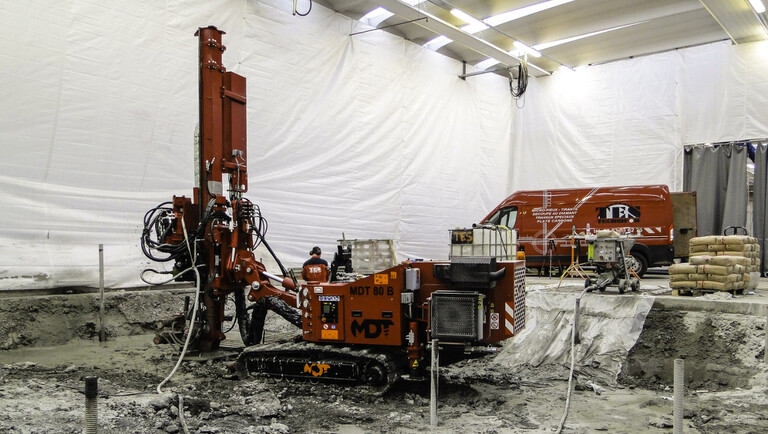
Micropiles transfer the loads from the house to deeper soil layers with sufficient bearing capacity. However, they create discrete support points whose stiffness contrasts with that of the existing strip footings.
When micropiles are installed beneath strip footings, the existing footings are generally too flexible to distribute the loads between these new support points on their own.
The construction of connecting and stiffening ground beams, designed by a structural engineering consultancy, therefore forms an essential part of the system. These ground beams are intended to:
-
carry the loads from walls and columns;
-
distribute the loads between the micropiles;
-
connect the various support points;
-
reduce the risk of differential settlement;
-
maintain consistent behaviour throughout the structure.
Micropile underpinning must not therefore be reduced to drilling beneath a few cracked sections of the house. It must form a complete, coherent and properly designed foundation system.
The Specific Case of Resin Injection
Expanding resin injection may be proposed in certain circumstances, but it is not a universal solution.
TES TECHNIFOR strongly advises against this method in clay soils that are sensitive to shrink–swell movement. The treatment has little effect on the clay’s natural sensitivity to changes in moisture content.
It is also difficult to achieve perfectly uniform injections. A localised increase in bearing capacity may therefore create differences in behaviour between treated and less effectively treated areas, potentially causing further damage or an additional loss in subsequent years.
If resin injection were nevertheless selected, it should:
-
be preceded by an appropriate G5 geotechnical diagnostic investigation;
-
be justified in relation to the nature of the soil and the identified cracking mechanism;
-
be subject to precise design and engineering calculations;
-
be carried out under a G4 geotechnical supervision assignment.
The G4 assignment must be entrusted to a geotechnical engineering consultancy that is independent of the company carrying out the injections. Its purpose is to verify that the work complies with the adopted assumptions and specifications, assess any deviations and evaluate the results obtained.
This supervision is particularly important when the client is a private homeowner without specialist technical knowledge. The independent consultancy protects the homeowner’s technical interests and provides the expertise required to assess the method, the injection procedures and their potential consequences for the future behaviour of the house.
Repairing the Structure after Stabilisation
Underpinning addresses the geotechnical cause of the damage or stabilises the foundations, but it does not immediately close the existing cracks.
A monitoring period is generally required before the walls, façades and structural elements can be permanently repaired. Depending on the circumstances and the conclusions of the investigations, these repairs are commonly carried out one to two years after the underpinning work.
During this period, crack monitoring gauges can be used to confirm that any residual movement remains compatible with permanent repairs.
Once stabilisation has been confirmed, TES TECHNIFOR can carry out the appropriate work, including:
-
crack stitching;
-
replacement or repair of damaged masonry;
-
installation of structural tie rods;
-
strengthening of walls and load-bearing elements;
-
steel or carbon-fibre reinforcement;
-
additional structural repairs specified by the engineering study.
Rendering, painting and decorative finishes are completed after the structural work, once its effectiveness and the stability of the building have been confirmed.
How Is Your Project Managed?
-
You send us your enquiry
The site address, photographs of the cracks, available drawings, the history of the damage and any existing reports. -
We carry out an initial assessment
We review the nature of the damage, its known progression, the configuration of the house and any investigations already completed. -
An independent investigation is arranged where necessary
This may include a G5 geotechnical investigation, a structural assessment, foundation inspections and the installation of connected crack monitoring gauges. -
The repair solution is defined
The method, design, work sequence and treatment of all foundations, load-bearing walls and columns are established. -
The work is carried out
This may include making the area safe, underpinning, micropiles, ground beams, structural strengthening or other specified work. -
Independent supervision may be provided
Under a G4 assignment, the geotechnical engineering consultancy verifies that the work is compliant and assesses any proposed adjustments. -
Stabilisation is confirmed
A monitoring period is used to assess the behaviour of the house before structural repairs and final finishes are completed.
Preparing Your Enquiry
The services described on this page are available only for houses located in Lorraine.
To enable us to carry out an initial assessment, please provide th