Description
Injection, Repair and Consolidation of Structures and Soils
TES TECHNIFOR carries out resin and cement grout injection works for the repair of concrete, stone and masonry structures, as well as for the treatment, filling and consolidation of certain soils.
Depending on the type of structure and the required outcome, injection techniques can be used to seal cracks, restore structural continuity, fill voids, limit certain water ingress or flows, and locally improve the mechanical properties of the ground.
The choice of injection material and method depends on the substrate, the nature and cause of the damage, the possible presence of water, the characteristics of the soil and the required function.
Resin Injection in Concrete Structures
Cracks in concrete structures can have many different causes, including shrinkage, structural movement, mechanical loading, construction defects, reinforcement corrosion or accidental damage.
Before any repair work is carried out, it is therefore important to understand the cause, behaviour and potential evolution of the cracking.
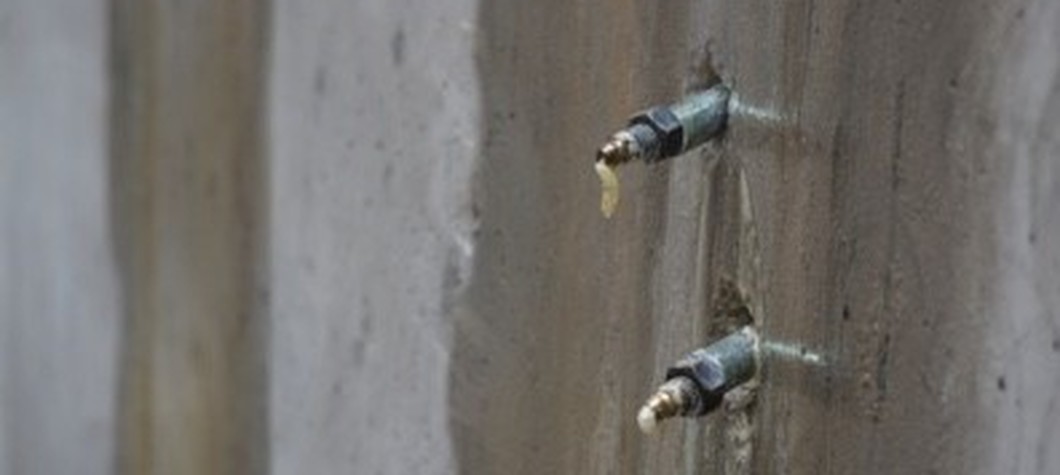
Where appropriate, certain cracks can be treated by pressure injection of resin.
Depending on the objective and the characteristics of the crack, injection can be used for:
- filling cracks;
- restoring structural continuity;
- treating through-cracks;
- limiting certain types of water ingress;
- localised treatment of defects or discontinuities within the concrete.
Different types of resin can be used depending on the required performance and site conditions.
Substrate preparation, injector positioning, selection of the appropriate product and control of injection pressures are all essential to the quality of the repair.
Injection and Repair of Masonry and Stone Structures
TES TECHNIFOR also works on stone structures and existing masonry.
Older structures may present cracking, deteriorated joints, internal voids, separation between components or loss of cohesion requiring a repair method adapted to the construction of the structure.
Depending on the diagnosis and configuration of the structure, the works may involve the injection of resins, grouts or other materials suited to the existing substrate.
Applications may include:
- stone walls;
- historic and traditional masonry;
- load-bearing masonry walls;
- civil engineering structures;
- masonry containing cracks or internal voids;
- structures requiring localised consolidation.
The nature, porosity and condition of the existing materials must be taken into account when selecting the injection material and method.
Cement Grout Injection into Soils
TES TECHNIFOR also carries out cement grout injection into soils.
This technique involves injecting cementitious grout into the ground to fill voids or locally improve certain soil characteristics.
It is particularly applicable to certain granular and sandy soils, provided that their particle-size distribution and permeability are compatible with the grout and injection method selected.
Depending on the project, injection may be used to:
- consolidate certain soils;
- fill underground voids;
- locally improve the mechanical properties of the ground;
- treat loosened or decompressed zones;
- limit certain groundwater flows;
- support underpinning operations;
- treat the ground beneath or adjacent to existing foundations.
The feasibility and effectiveness of the treatment depend directly on the geotechnical characteristics of the soil and the injectability of the grout.
Injection Methods Adapted to Ground Conditions
Ground injection involves much more than simply pumping grout under pressure.
The injection method must be determined according to the geotechnical characteristics of the ground, surrounding structures and the required outcome.
Depending on the project, the design and execution of the treatment may take into account:
- soil type and particle-size distribution;
- permeability;
- possible presence of groundwater;
- depth of the treatment zone;
- required injection volumes;
- grout characteristics;
- injection pressures;
- proximity of existing foundations and structures;
- risks of movement or uplift of surrounding structures.
Monitoring injection pressures and volumes makes it possible to control the operation and adapt the treatment to the response of the ground.
Expanding Resin Injection Beneath Floor Slabs
Expanding resin injection beneath floor slabs was notably developed to address rocking or loss of support beneath industrial floor slabs.
Where a floor slab has locally lost contact with its supporting ground or voids have developed beneath it, expanding resin injection can be used to fill these voids and restore contact between the slab and its supporting base.
In certain configurations, and with appropriate monitoring, expansion of the resin can also be used to locally correct differences in slab level.
This technique therefore has relevant applications when used to address a problem compatible with its operating principle.
Its use has subsequently been extended to other applications, including ground treatment beneath foundations and buildings affected by settlement or damage following periods of drought.
Expanding Resin and Drought-Related Damage: Limitations of the Technique
TES TECHNIFOR does not offer expanding resin injection as a foundation strengthening solution for buildings affected by damage related to shrink-swell behaviour of clay soils.
This position is based on the mechanism responsible for this type of damage.
In clay soils susceptible to shrink-swell behaviour, changes in moisture content cause variations in soil volume. During periods of drought, near-surface clay layers may shrink; when moisture levels subsequently increase, they may swell again.
The resulting differential ground movements can cause foundation displacement and cracking within the building structure.
Localised expanding resin injection may fill certain voids or locally modify the mechanical characteristics of the ground, but it does not eliminate the inherent sensitivity of near-surface clay soils to variations in moisture content.
The geotechnical mechanism responsible for the damage may therefore remain after the intervention.
For this reason, in cases involving drought-related damage, TES TECHNIFOR favours an approach based on geotechnical and structural analysis of the causes of ground movement before selecting the appropriate strengthening technique.
Underpinning and Micropiles in Cases of Foundation Movement
Where investigations indicate that structural loads need to be transferred to deeper soil layers with suitable mechanical characteristics, micropile underpinning may be considered.
The principle is different from that of shallow ground injection: structural loads are transferred through the micropiles to soil layers identified through the geotechnical investigation and the design of the underpinning system.
TES TECHNIFOR installs Type II, III and IV micropiles and operates compact drilling rigs that enable work to be carried out inside existing buildings and on restricted-access sites.
The objective is to select the strengthening technique according to the actual mechanism responsible for the damage, rather than systematically applying the same process to every type of structural or geotechnical problem.
Injection, Micropiles or Another Strengthening Technique?
There is no single technique suitable for every structure and every type of ground.
Depending on the cause of the damage, soil characteristics, structural behaviour and objectives of the works, the solution may involve:
- resin injection into a concrete structure;
- injection into masonry or stone structures;
- cement grout injection into the ground;
- void filling;
- structural repair;
- foundation strengthening;
- underpinning using micropiles;
- or a combination of several techniques.
The strengthening technique must be selected according to the cause of the damage and the characteristics of the structure.
Expertise Combining Geotechnics, Foundations and Structures
One of TES TECHNIFOR's key strengths lies in the complementary nature of its specialist activities.
Our expertise in structural assessment, engineering and design, injection, micropiles and special foundations, underpinning, structural strengthening, concrete sawing and core drilling enables us to take a comprehensive approach to the interaction between the ground, foundations and existing structures.
This approach is particularly important where cracking or other damage observed in a building may originate from movement of its foundations.
Depending on the project requirements, our intervention may therefore combine:
structural assessment → investigations → geotechnical and structural analysis → definition of the solution → injection or strengthening → structural repair.
Resin and Cement Grout Injection in Grand Est and Paris
Based in Gondreville, near Nancy, TES TECHNIFOR carries out resin injection, cement grout injection, repair and consolidation works throughout Grand Est and the Paris region.
Our teams operate particularly in Nancy, Metz, Reims, Strasbourg, Colmar and Paris, as well as on technically demanding projects throughout north-eastern France.
We work on existing buildings, industrial facilities, civil engineering structures, historic masonry and projects requiring specialist repair or strengthening works.
Do You Have an Injection or Consolidation Project?
Concrete cracking • cracked masonry • stone structures • void filling • rocking floor slabs • loosened ground • cement grout injection • foundation strengthening • damage caused by ground movement
Contact TES TECHNIFOR to assess your project and determine the injection, repair or strengthening technique best suited to your structure.